ARTICLE
SAP + Reltio: A Defining Moment for Modern Master Data Management
SAP’s acquisition of Reltio is more than a market move. It is a clear signal.

Industry Perspective
SAP’s acquisition of Reltio is more than a market move. It is a clear signal that Master Data Management has moved from legacy governance discipline to a critical foundation for AI, analytics, and enterprise operations.
The MDM of today is not the MDM many enterprises remember from 10 to 15 years ago.
First, it is worth saying clearly: this is a positive moment for the category.
Reltio has built one of the most capable modern MDM platforms in the market, and SAP’s decision to acquire the company is a strong validation of where enterprise data strategy is heading. It reinforces a broader truth that more organisations are now confronting directly: trusted, connected, governed data is essential if AI is going to deliver meaningful business value.
Quote
“AI cannot reach its full potential when data is fragmented.”
SAP announcement
For many enterprise teams, MDM still carries the baggage of an earlier era. Slow programmes. Heavy modelling. Long implementation cycles. Value delayed until the end of a large transformation effort.
That perception is now out of date.
Modern Master Data Management is increasingly cloud-native, real-time, and designed to support fast-changing operational environments. It is expected to onboard data faster, adapt continuously, and serve not just reporting and governance requirements, but AI, automation, and enterprise decision-making too.
That matters because enterprises are no longer operating in static data environments. They are managing multiple platforms, fragmented sources, and growing pressure to make trusted, high-quality data ready for AI quickly and responsibly.
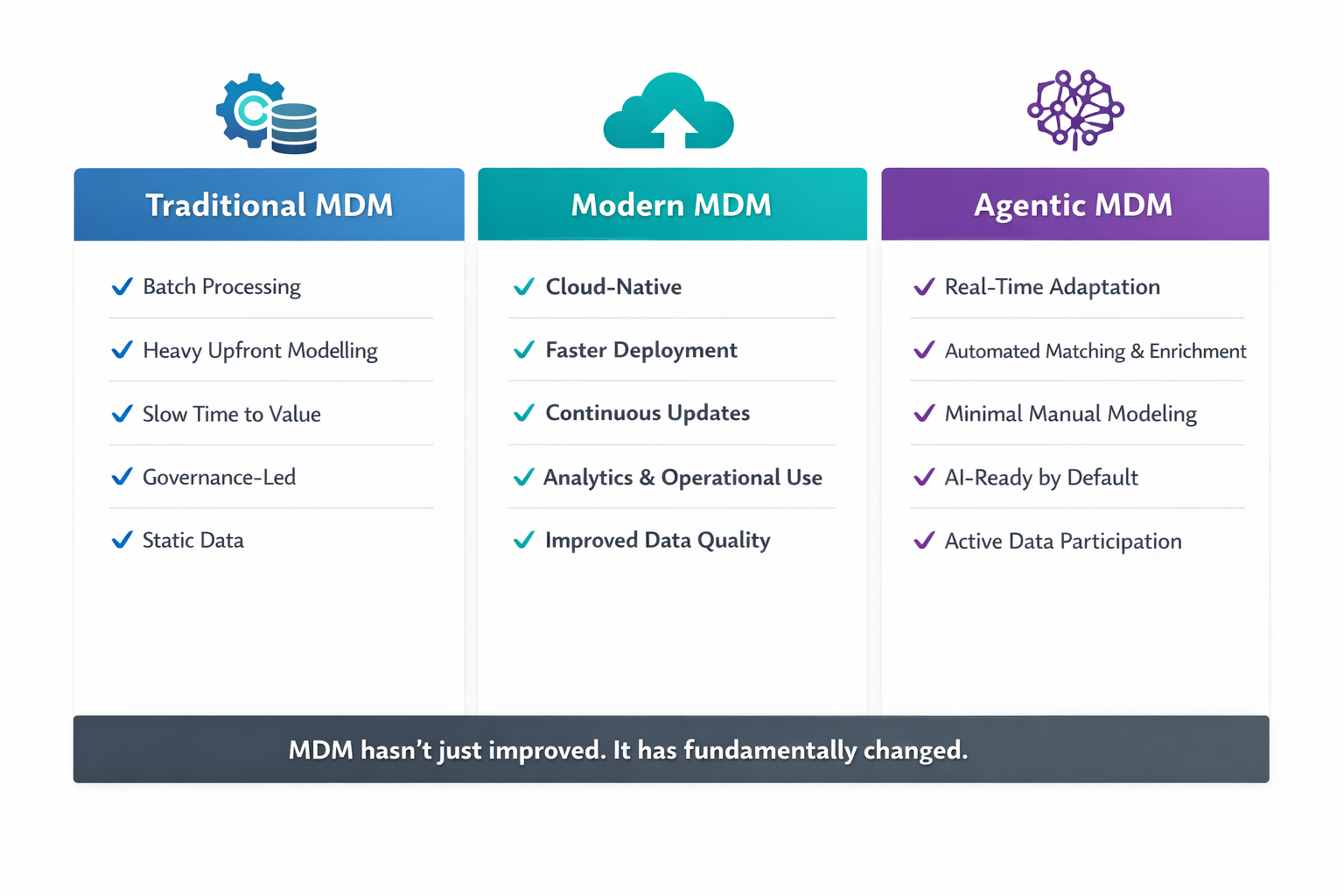
Modern MDM has already moved beyond slow, project-based delivery. But the next shift is even more significant. It is not just about managing data faster. It is about systems that actively participate in how data is understood, improved, and used.
This is where Agentic Master Data Management is emerging.
In this model, MDM is no longer a static layer. It becomes an active, intelligent part of the enterprise data ecosystem, which is exactly why agentic data management platforms are attracting so much attention.
SAP’s move makes one thing unmistakable: MDM is no longer peripheral. It is moving closer to the centre of enterprise architecture.
That is happening for a simple reason. AI outcomes depend on data that is not just available, but high quality, connected, and governed in context. Fragmented data remains one of the biggest barriers to turning AI ambition into production value.
Why this matters
Gartner predicts that through 2026, organizations will abandon 60% of AI projects unsupported by AI-ready data.
That is why this acquisition matters beyond SAP and Reltio themselves. It is another proof point that MDM is not a legacy category waiting to be replaced. It is being redefined as a critical enterprise capability.
Quote
“Make SAP and non-SAP data AI-ready.”
SAP announcement headline
As MDM becomes more strategic, the decision for enterprises is no longer just which platform to buy.
The deeper question is how data should be controlled across the enterprise.
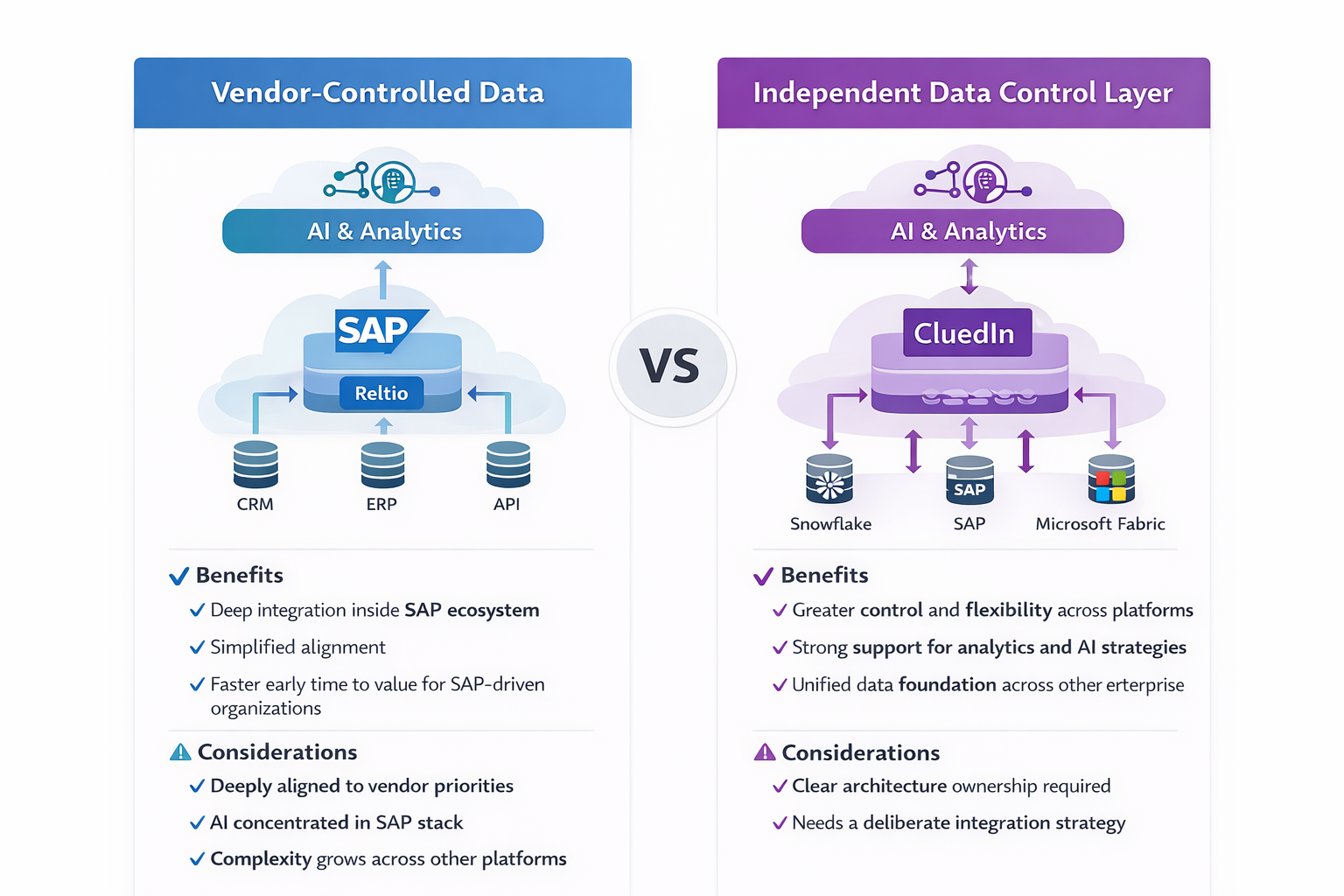
Broadly, two models are becoming more visible.
In this model, MDM is tightly aligned with a specific vendor ecosystem.
Benefits
Considerations
In this model, MDM operates as a neutral layer across multiple systems and platforms.
Benefits
Considerations
This is not a narrow architectural debate. It affects business outcomes directly.
AI outcomes
Can trusted data be used consistently across systems, models, and teams?
Speed
How quickly can new data sources and use cases be activated?
Risk and cost
How much friction is created when platforms, strategies, or operating models evolve?
The more ambitious organisations become with AI, the more visible these trade-offs will be. MDM is no longer a back-office governance function. It is becoming part of the performance layer of the enterprise, especially where analytics and AI platforms such as Microsoft Fabric are central to the roadmap.
CluedIn is built for this new generation of MDM.
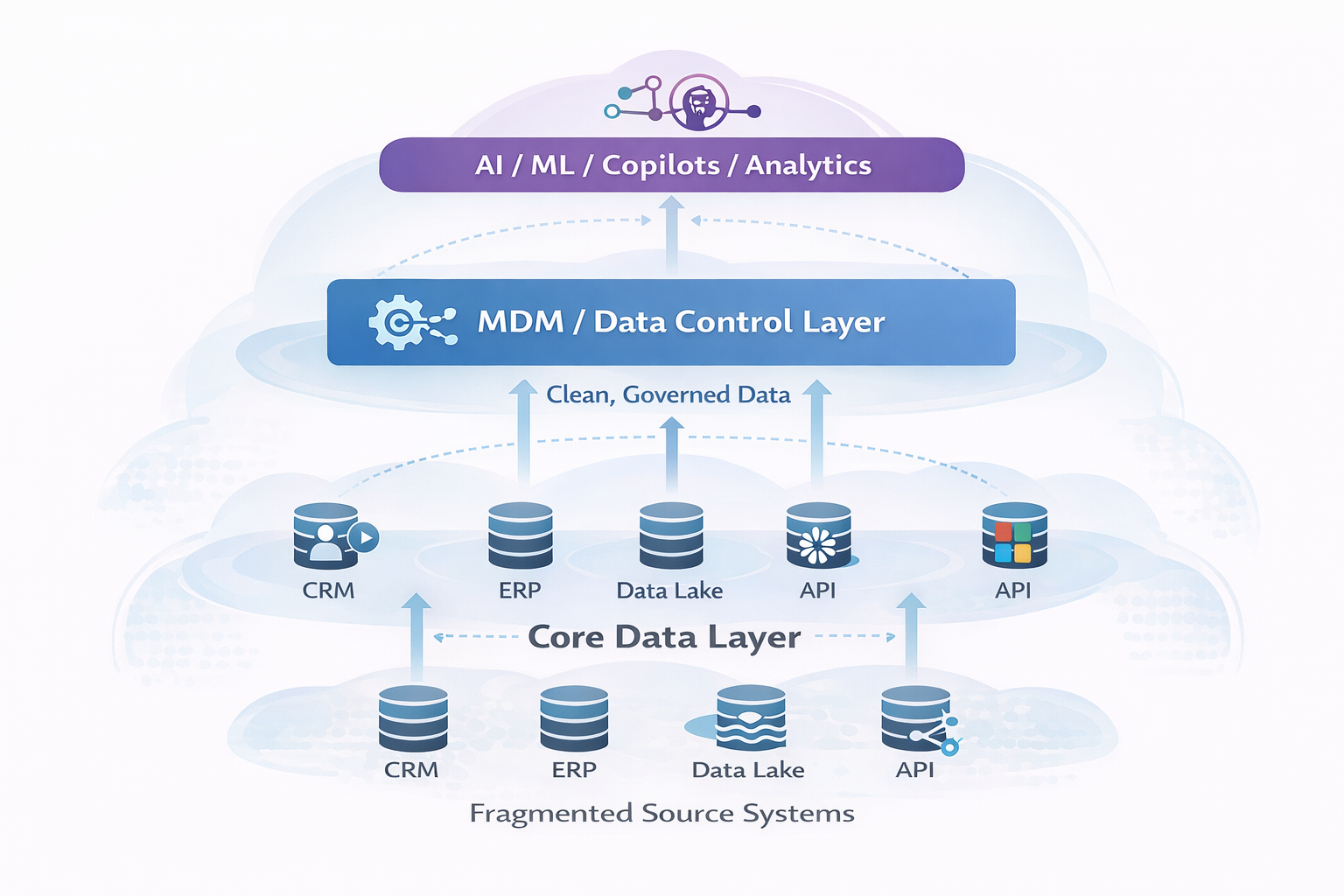
As an independent data control layer, CluedIn enables organisations to unify, govern, and activate data across SAP, Microsoft, and beyond, while keeping control over how that data is structured, trusted, and used.
For readers exploring this in more depth, CluedIn’s pages on data quality, solutions and use cases, and the changing MDM market give useful context on how this category is evolving.
SAP’s acquisition of Reltio is a strong validation of the direction of travel for the market. It shows that MDM is evolving from a slow, project-based discipline into a fast, continuous, and strategically important capability. For enterprise leaders, the opportunity now is bigger than simply modernising MDM.
It is to rethink how data is controlled, trusted, and activated in an AI-driven world.
The organisations that get that right will not just manage data better. They will move faster, innovate with more confidence, and create more value from AI.
If you are evaluating how to modernise your MDM strategy for AI, explore the CluedIn Agentic Master Data Management platform and see how an independent data control layer can work in practice.