Article
The Definitive Guide to Continuous Master Data Management with AI
The rise of continuous Master Data Management with AI, implemented through agentic data management platforms.

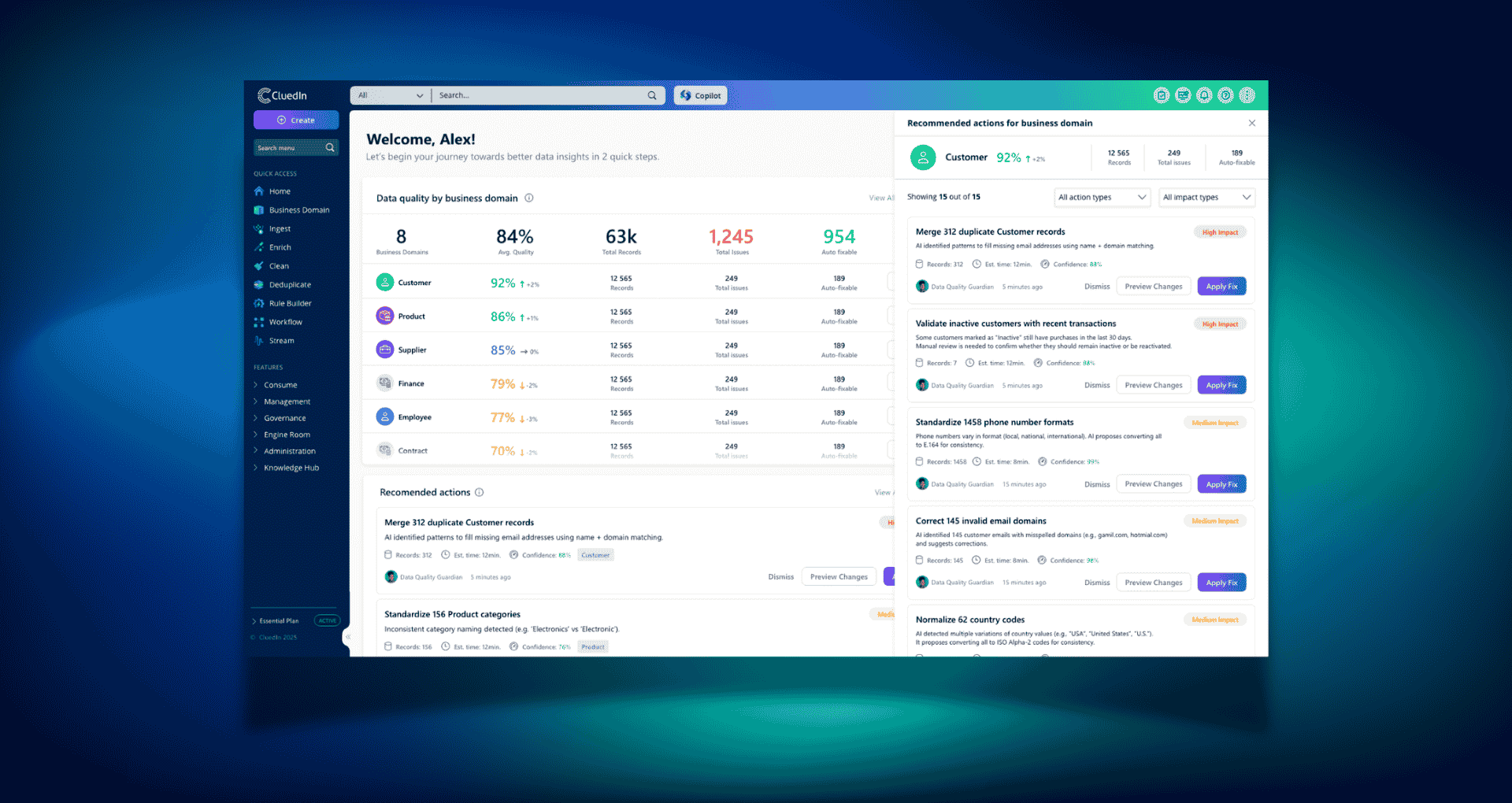
Modern enterprises operate in a state of constant data change. Customer information updates across CRM systems, product attributes evolve in commerce platforms, suppliers shift across procurement tools, and regulatory requirements continuously reshape governance expectations.
Traditional Master Data Management was designed for a slower world. Data was ingested periodically, models were carefully designed in advance, and golden records were recalculated in scheduled cycles.
That model is now breaking down.
AI, distributed cloud systems, and the rapid growth of operational data require a continuous approach to Master Data Management, where data is unified, corrected, and governed in real time rather than through periodic projects.
This shift has given rise to continuous Master Data Management with AI, often implemented through agentic data management platforms. In these systems, autonomous AI agents act as digital data stewards, continuously monitoring and improving master data while human experts maintain oversight and governance.
Continuous Master Data Management is an operational model where master data is continuously unified, improved, and governed using automation and AI driven workflows.
Rather than periodically rebuilding golden records through batch processes, continuous MDM maintains trusted records in place and in real time as new data arrives.
Continuous Master Data Management is an approach that leverages AI automation to synchronize, cleanse, and unify master data in real time, ensuring golden records always reflect the latest enterprise information.
This model enables:
The shift to continuous MDM addresses several structural weaknesses in traditional implementations.
Conventional MDM projects often face three systemic challenges:
Data models must be designed in advance before onboarding new systems.
Golden records are recalculated periodically rather than continuously.
Organizations replicate data across integration pipelines and warehouses.
In rapidly evolving digital environments, these limitations lead to outdated records, governance gaps, and costly operational friction.
| Dimension | Traditional MDM | Continuous MDM |
|---|---|---|
| Update frequency | Scheduled batch updates | Real time event driven updates |
| Automation | Manual rules and scripts | AI driven automation |
| Data onboarding | Manual mapping | AI assisted schema discovery |
| Governance | Periodic reviews | Continuous policy enforcement |
| Human effort | High operational overhead | Human review only for exceptions |
| Golden records | Periodically recalculated | Continuously maintained |
Continuous MDM transforms master data from a periodic integration exercise into an always operating system for trusted enterprise data.
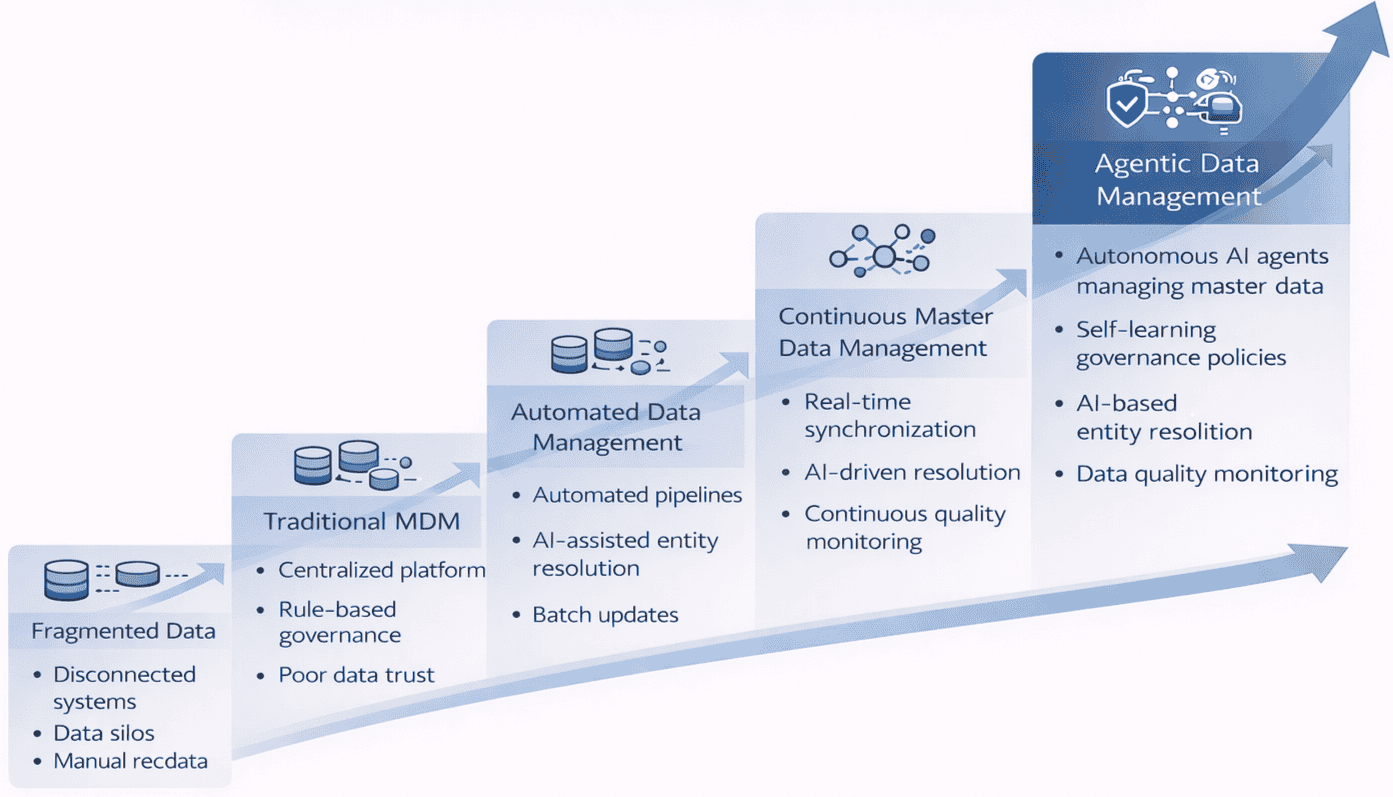
The Agentic Master Data Management maturity model describes how organizations evolve from fragmented data systems to fully autonomous AI-driven data governance.
Early stages rely on manual data stewardship and rule-based processes. More advanced stages introduce AI-assisted automation and real-time synchronization. At the highest level of maturity, autonomous AI agents continuously manage and improve enterprise master data while humans provide governance oversight.
Agentic data management is the architectural model that enables continuous master data management.
In this approach, autonomous AI agents operate across enterprise data systems to discover, unify, govern, and improve master data.
Agentic data management leverages autonomous AI agents to discover, unify, govern, and correct master data across systems while continuously learning from human feedback.
These AI agents function as digital data stewards, capable of performing tasks that traditionally required large teams of data engineers and governance specialists.
Typical agent capabilities include:
Importantly, these agents operate within governance guardrails, meaning they can automate routine work while escalating ambiguous or high risk decisions to human experts.
This model creates a hybrid governance approach, combining AI autonomy with human oversight.
Traditional data governance relies heavily on static rules.
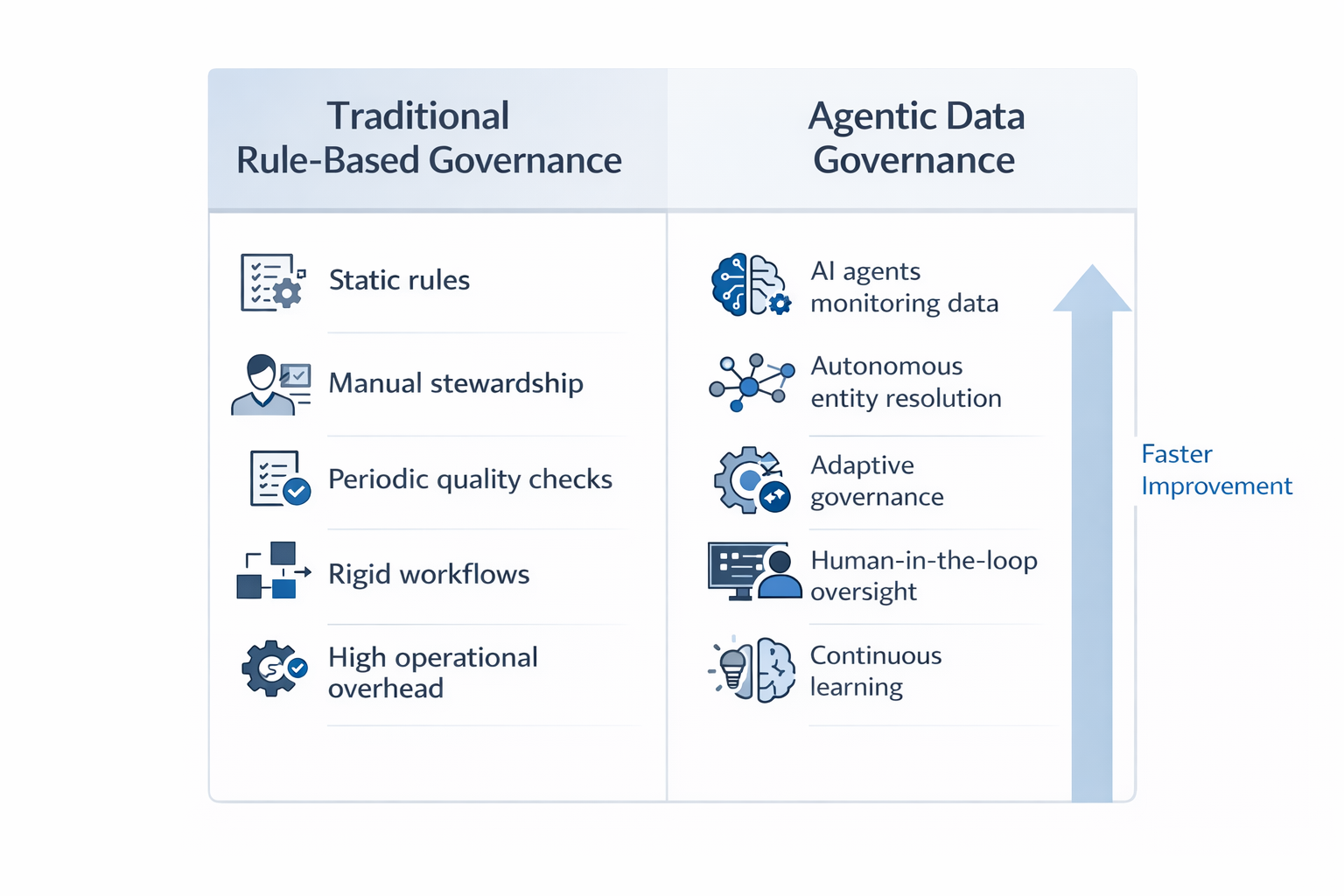
Image: Agent Based Governance vs Rule Based Systems
Rules specify exact conditions such as:
If field = null → reject record
If duplicate found → merge record
While effective for simple scenarios, rule based systems struggle with real world data complexity. Agent based governance introduces adaptive decision making.
| Capability | Rule Based Governance | Agent Based Governance |
|---|---|---|
| Decision logic | Static predefined rules | Context aware AI interpretation |
| Adaptability | Requires manual rule updates | Learns from feedback |
| Data quality remediation | Manual intervention | Automated remediation |
| Scalability | Limited by human rule creation | Scales with AI automation |
| Handling ambiguity | Fails or escalates | Uses probabilistic reasoning |
| Human role | Operational execution | Oversight and policy definition |
In practice, agentic governance systems can resolve issues such as fuzzy entity matches, schema inconsistencies, and conflicting records far more efficiently than rigid rule sets.
Human stewards remain involved for:
This human in the loop model ensures trust while dramatically reducing operational workload.
AI agents orchestrate the full lifecycle of Master Data Management.
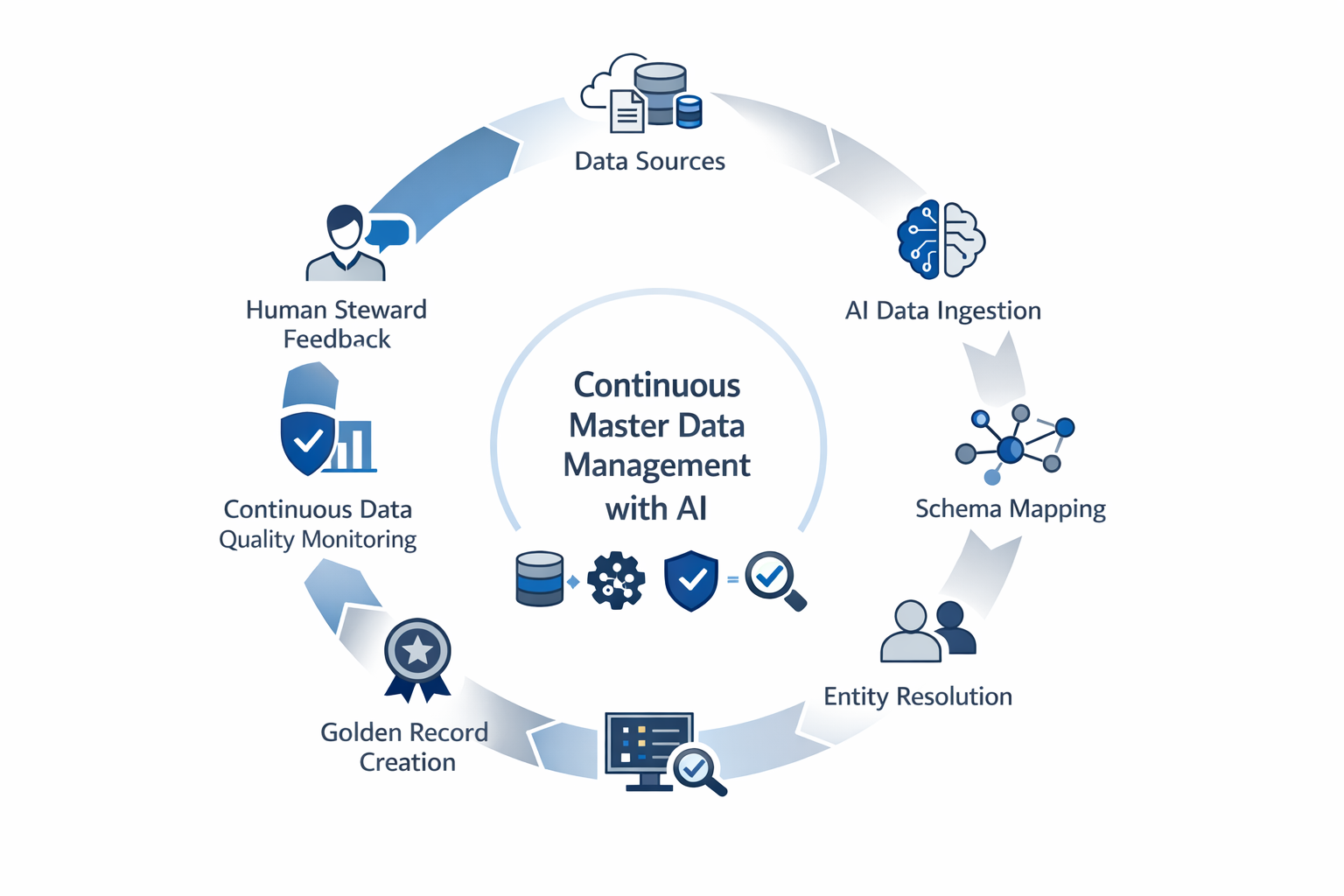
AI agents continuously improve master data while humans oversee exceptions.
Instead of executing a static pipeline, they operate as autonomous workflows continuously improving enterprise data.
This creates a continuous improvement loop for data quality and governance.
AI introduces several capabilities that significantly change how master data platforms operate.
AI models analyze source structures and automatically infer schema relationships.
Entity matching algorithms identify duplicates and relationships across datasets.
AI models continuously monitor for anomalies such as invalid addresses, inconsistent classifications, and suspicious record changes.
AI can tag datasets with contextual metadata describing ownership, classification, lineage, and quality indicators.
This reduces the time required to onboard new systems from months to days. High performing systems can automate the majority of matching decisions.
Example results from industry deployments include automated match rates exceeding 97 percent, dramatically reducing manual stewardship effort.
Rather than reacting to errors, organizations can detect quality issues proactively. Improved metadata dramatically increases data discoverability and reuse.
Adopting continuous MDM requires both technology and operational changes. Successful implementations typically follow a pilot first strategy.
| Phase | Objective |
|---|---|
| Discovery | Identify high value data domains |
| Data onboarding | Connect and profile source systems |
| Schema mapping | Establish cross system relationships |
| Entity resolution | Configure deduplication models |
| Governance workflows | Define stewardship policies |
| Monitoring | Track quality metrics and agent performance |
| Domain expansion | Extend across additional entities |
The most successful projects start with one high impact domain such as customer data or supplier records. This approach allows organizations to validate outcomes before scaling enterprise wide.
Clear measurement is essential to prove value. Typical success metrics include:
For example, improvements in master data quality often lead to measurable outcomes such as:
One of the most time consuming tasks in traditional MDM is mapping source schemas. AI dramatically accelerates this process.
Schema mapping leverages AI models to identify relationships between fields across systems and propose mapping suggestions.
For example:
Benefits include:
Entity resolution is the core of Master Data Management. Machine learning models evaluate multiple signals to determine whether two records represent the same entity.
Signals can include:
Continuous monitoring ensures duplicates and inconsistencies are corrected automatically or escalated to human stewards when confidence is low.
Automation does not eliminate governance. Instead, it shifts governance toward policy definition and oversight. Effective governance frameworks include:
This ensures that even as automation increases, accountability and transparency remain intact.
Data environments evolve continuously. Therefore, MDM models must also evolve. Organizations should monitor:
Regular model retraining ensures that AI agents remain accurate as business rules and data patterns change.
Once a pilot domain succeeds, organizations can expand continuous MDM across additional entities.
Typical expansion order:
Modern architectures rely on:
These capabilities allow master data to be distributed across operational and analytical systems in real time.
AI automation must be paired with human governance. This approach is known as human in the loop data management.
Humans typically review decisions involving:
Human oversight provides three key benefits:
Modern agentic data platforms combine three architectural layers.
Graph models represent entities and relationships natively.
This makes it easier to resolve complex relationships such as:
customer → account → location → asset
Autonomous AI agents manage:
API first architecture enables integration with modern data ecosystems including:
Graph structures dramatically improve entity resolution and data lineage visibility.
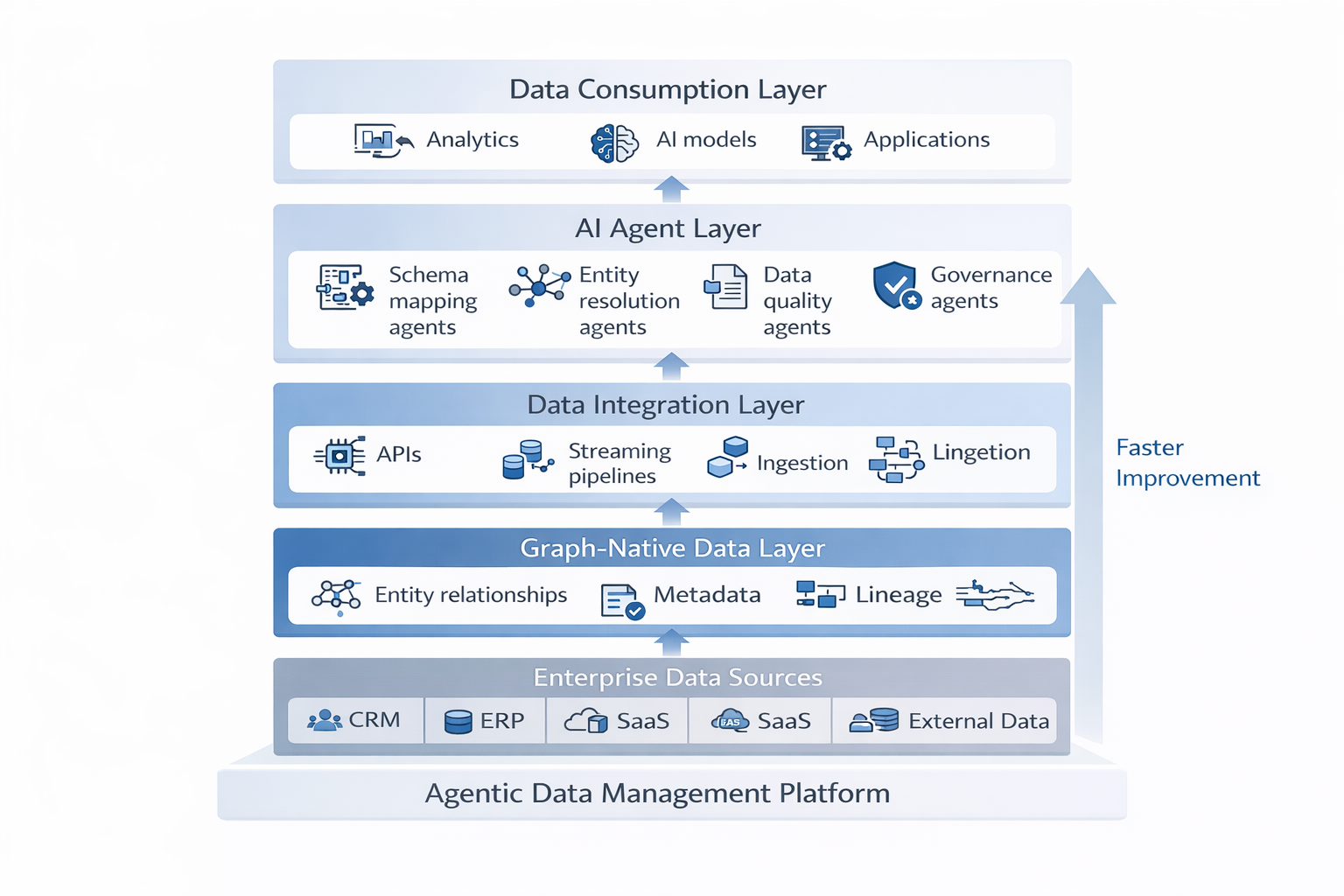
Image: Continuous Master Data Management
Platforms such as CluedIn combine these architectural layers to enable agentic Master Data Management without heavy manual modelling, allowing enterprises to onboard and govern data faster.
Organizations adopting AI driven MDM commonly report measurable improvements.
| Outcome | Impact |
|---|---|
| Faster data onboarding | weeks instead of months |
| Automated entity resolution | over 90 percent automation |
| Duplicate reduction | significant reduction in data errors |
| Improved metadata quality | greater data discoverability |
| Reduced governance workload | stewards focus on high value decisions |
These improvements directly enable better analytics, AI readiness, and regulatory compliance.
European enterprises face particularly strong pressures around data governance and sovereignty.
Regulations such as GDPR require:
Agentic data management platforms help address these challenges by combining automation with explainable governance.
Continuous MDM allows organizations to maintain trusted master data while meeting these regulatory expectations.
Organizations evaluating agentic MDM should consider the following approach:
Start with a focused high value pilot domain
Establish governance and stewardship workflows early
Use AI to automate onboarding and entity resolution
Maintain human oversight for sensitive decisions
Monitor quality metrics continuously
Expand domain by domain across the enterprise
Enterprises that adopt continuous, AI driven MDM early will be better positioned to support advanced analytics, AI initiatives, and regulatory compliance.
The scale and complexity of modern enterprise data means traditional governance approaches are no longer sufficient. For more on this topic, download our most recent white paper, Data Has Outgrown Humans.
Platforms such as CluedIn enable organizations to implement agentic Master Data Management in modern cloud environments.
Continuous Master Data Management uses AI driven automation to keep master data synchronized, accurate, and governed across enterprise systems at all times.
AI agents automatically detect errors, identify duplicates, and suggest corrections while learning from human feedback to improve accuracy over time.
Human stewards review ambiguous or high risk decisions, ensuring compliance and maintaining trust in automated governance processes.
Agentic platforms use autonomous AI agents to continuously manage data, whereas traditional MDM relies heavily on static rules and manual processes.
Start with a pilot domain, define measurable KPIs, automate onboarding and governance workflows, maintain human oversight, and scale gradually across domains.