MDS remains supported in SQL Server 2022 and earlier releases. Existing installations do not suddenly stop working because SQL Server 2025 exists.
But Microsoft has removed Master Data Services from SQL Server 2025. That changes the question for architects from "How do we upgrade MDS?" to "How do we get the data, rules, hierarchies, integrations and consumers out of MDS without recreating the same technical debt somewhere else?"
What this guide covers
The migration mechanics, the MDS-to-CluedIn concept mapping, where Fabric and Purview fit, and what Microsoft and other third parties have actually published about CluedIn.
The aim is not to produce another generic "modernise your data" article. It is to separate what is technically useful from what is merely marketing shorthand.
First, what does Microsoft actually say?
Microsoft's current position on Master Data Services is straightforward.
Microsoft Learn
"MDS is removed in SQL Server 2025 (17.x)."
Microsoft also confirms that MDS remains supported in SQL Server 2022 and earlier versions.
That distinction is important. There is time to migrate properly. There is considerably less justification for designing new architecture around MDS.
And where does CluedIn appear?
This is where the history becomes useful. Microsoft's Architecture Center repository contains a reference architecture titled:
Historical Microsoft architecture
Migrate master data services to Azure with CluedIn and Azure Purview
The live Architecture Center has evolved since then, but the original MicrosoftDocs architecture metadata remains publicly visible. That matters because it establishes that the CluedIn/MDS relationship did not appear only after Microsoft removed MDS from SQL Server 2025.
A Microsoft-hosted presentation from 2022, End-to-end Data Estate Lineage with Purview and CluedIn, also includes that same MDS migration architecture in its resource material.
Source: Microsoft-hosted presentation
The Microsoft references did not disappear with the old MDS architecture
The current material has moved on from MDS migration specifically and into the wider MDM architecture. Microsoft Learn currently has a dedicated page titled Microsoft Purview and CluedIn integration for master data management.
Current Microsoft Learn
Microsoft describes the CluedIn architecture as providing a "coherent, consistent, end-to-end Master Data Management (MDM) solution."
That page covers ingestion, data quality, mastering, governance, graph relationships and downstream data delivery.
Microsoft also publishes a current guided project for building a complete master data management and data governance stack using Microsoft Purview and CluedIn.
The training walks through Azure Data Factory, CluedIn ingestion, streaming data back to ADLS, deduplication, cleaning, enrichment and Purview scanning.
Source: Microsoft Learn guided project
The evidence chain
MDS migration architecture → Azure and Purview MDM architecture → current Microsoft MDM training
The technology has moved forward. The architectural role has remained recognisable.
What does an MDS migration actually involve?
This is where migration projects often underestimate the problem. MDS is rarely just a database.
| MDS component |
What may depend on it |
| Models |
Domain boundaries and organisational ownership |
| Entities |
Master data objects |
| Members |
Business records |
| Attributes |
Data definitions and controlled values |
| Domain-based attributes |
Relationships between entities |
| Business rules |
Validation, defaults and data acceptance |
| Hierarchies |
Operational and reporting structures |
| Subscription views |
Downstream integration contracts |
| Change tracking |
Incremental integration |
| Excel Add-in |
Manual stewardship processes |
| Security |
Who can view and modify domains |
| Transaction history |
Audit and investigation |
The dependencies are more important than the tables.
An MDS migration should start by identifying what actually relies on MDS, not by assuming every object deserves to be recreated.
Three technical paths from MDS into CluedIn
There is no requirement to switch MDS off before CluedIn comes online.
01
Connect CluedIn directly to MDS
CluedIn has a dedicated Microsoft SQL Server MDS integration.
There is a practical technical issue to handle: MDS uses Windows authentication by default, while the CluedIn crawler runtime does not rely on Windows authentication in the same way.
CluedIn therefore documents direct connectivity where the network path permits it, and Azure Relay where an on-premises MDS server does not have a routable path to CluedIn.
On-premises MDS → Azure Relay → CluedIn
Useful when coexistence is required before MDS is retired.
02
Treat existing SQL outputs as migration contracts
Many mature MDS implementations already publish stable subscription views.
If those views are understood and trusted, they can provide a useful migration surface without forcing the team to reproduce the entire MDS model first.
The caution is obvious: a beautifully simple subscription view can hide years of assumptions and transformation logic underneath it.
03
Use both
For larger estates, this is often the sensible route.
Connect directly to MDS first to establish parity, identity and downstream publishing. At the same time, begin replacing the dependency on MDS with cleaner ingestion from original source systems or curated upstream datasets.
MDS disappears from the middle only after the replacement path has earned confidence.
Hybrid migration
Phase 1: Source systems → MDS → CluedIn → Consumers
Phase 2: Source systems → CluedIn → Consumers
How MDS concepts map into CluedIn
Some concepts map cleanly. Others should change.
| Microsoft MDS |
CluedIn approach |
| Model |
Data model scope across Business Domains |
| Entity |
Business Domain |
| Member |
Mastered record |
| Attribute |
Vocabulary Key |
| Domain-based attribute |
Relationship between Business Domains |
| Business rules |
Validation, quality, survivorship and publishing logic |
| Hierarchies |
Graph relationships and controlled classification structures |
| Validation issues |
Quality exceptions and failed checks |
| Subscription views |
Streams and Export Targets |
| Change tracking |
Event-log Streams |
| Data steward |
Data steward / data owner with increased focus on exceptions and policy |
Technical mapping: CluedIn MDS migration playbook
Do not copy MDS business rules line for line
An MDS business rule can do several different jobs.
It might validate a value. It might set a default. It might determine whether a record is valid enough to publish. It might trigger something operational.
Years later, all of those behaviours can be buried inside the same rule estate.
The business requirement should survive. The implementation does not always need to.
In CluedIn, validation, data quality, survivorship, workflow and publishing logic can be separated into the controls that actually own those responsibilities. That is more useful than recreating old coupling because "that is how MDS did it."
Subscription views deserve special treatment
In many MDS environments, subscription views are where the real operational dependency lives.
Finance pulls one.
The warehouse loads another.
A CRM integration depends on a third.
Someone has an Excel workbook connected to a fourth.
That is why CluedIn's adoption guidance recommends starting with consumers and contracts rather than attempting to perfect the whole model first. In CluedIn, mastered data is typically distributed using Streams and Export Targets.
Synchronized streams
Maintain a downstream representation of mastered data.
Event-log streams
Emit create, update and delete events for event-driven consumers.
A useful migration test:
Can the replacement platform produce the data this consumer requires, with the same or better reliability, semantics and auditability?
What happens to hierarchies?
Do not flatten them because it makes migration easier. Parent-child structures, product hierarchies, customer ownership structures and organisational relationships often contain genuine business meaning.
CluedIn's graph-native model treats relationships as first-class elements rather than forcing all that context back into denormalised tables.
Supplier → Material → Product → Plant → Region
Relationships can provide context for matching, governance and agentic data operations.
What about the MDS Excel experience?
This deserves attention because many people experience MDS through Excel rather than through architecture diagrams.
CluedIn's technical guidance does not assume every manual maintenance process should simply be reproduced. Modern stewardship may use forms, governed workflows, application interfaces, controlled ingestion patterns or Power Platform experiences depending on the use case.
The steward's role changes too. Instead of becoming the person through whom every correction must pass, stewardship increasingly becomes exception handling, approval, policy definition and oversight.
Where Microsoft Fabric fits
Fabric does not turn into MDS because MDS disappeared. A solved Microsoft Fabric Community discussion from 2025 made the architectural point succinctly: Fabric does not contain a built-in replacement for legacy Master Data Services.
Community source: Microsoft Fabric Community
That is community guidance rather than Microsoft product documentation, but the distinction is technically useful. Fabric is extremely capable at data engineering, analytics and AI workloads. Master Data Management still has to deal with identity, mastering, relationships, survivorship, quality, stewardship and controlled distribution.
Operational systems
↓
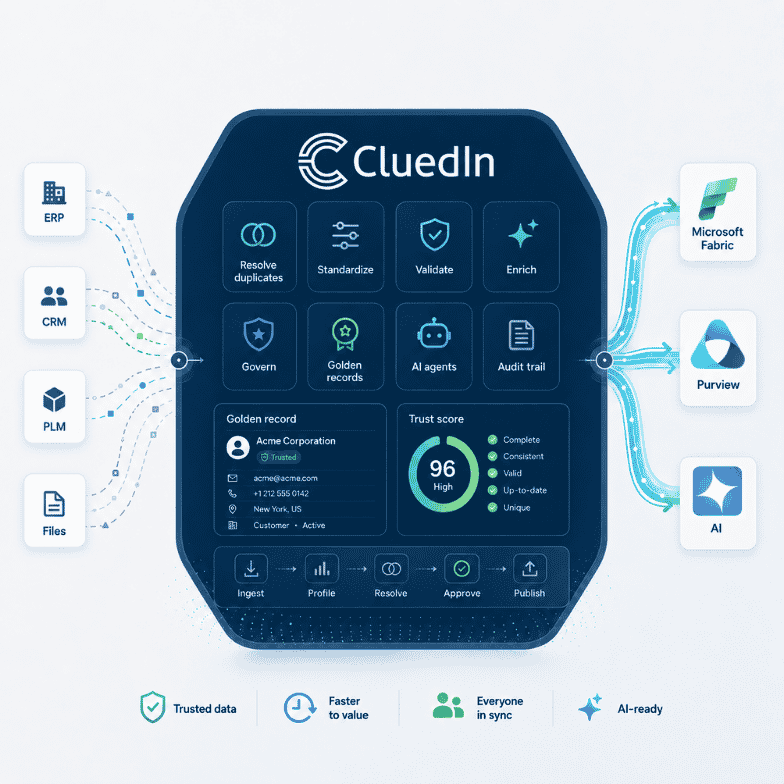
CluedIn: identity, mastering, quality, relationships and governed operations
↓
Fabric: data engineering, analytics, AI and consumption
And where does Purview fit?
Purview is equally important, but for a different reason. It is not simply "new MDS". Microsoft's current Learn architecture documents Purview and CluedIn working together across governance, lineage and operational MDM.
Microsoft Purview
Governance, discovery, lineage and understanding of the data estate.
CluedIn
Operational mastering, entity-level quality, matching, relationships, enrichment and governed data operations.
A practical migration sequence
A complicated MDS estate becomes much less frightening when the unit of migration is a consumer contract rather than the entire platform.
1. Inventory the MDS estate
Inventory dependencies, not just objects. Find the consumers, rules, hierarchies, identities and manual processes that still matter.
2. Pick one meaningful domain
Customer, Product or Supplier will usually expose more useful migration issues than a harmless lookup table.
3. Establish connectivity
Use direct MDS integration, Azure Relay or an existing SQL contract depending on the topology.
4. Preserve identity first
Establish business keys and identifiers before polishing every attribute. A clean record with the wrong identity is still the wrong record.
5. Translate the important rules
Separate validation, quality, survivorship and publishing concerns instead of reproducing legacy coupling unnecessarily.
6. Publish early
Create the first Stream and Export Target before declaring the mastering model "finished".
7. Dual run
Publish the new contract alongside the current MDS output. Compare, investigate differences and repeat until the behaviour is understood.
8. Move one consumer
Not the whole enterprise. One consumer. Then repeat.
The 90-day version
CluedIn's adoption playbook proposes a useful shape for proving the migration early.
DAYS 0–30
Prove one domain
Ingest one domain and prove one consumer contract end to end.
DAYS 31–60
Improve mastering
Improve matching and survivorship, then introduce a second consumer.
DAYS 61–90
Dual run and cut over
Reconcile outputs and move the first consumer away from MDS.
So, is CluedIn actually recognised outside CluedIn for this?
Yes. The important thing is to describe the evidence accurately.
Current Microsoft documentation
Microsoft Learn documents a complete CluedIn MDM architecture with Purview.
It also publishes a hands-on guided project using Purview, Azure Data Factory and CluedIn.
Historical Microsoft architecture
Microsoft's Architecture Center repository contains an explicit MDS-to-CluedIn migration architecture.
Microsoft's own Purview and CluedIn webinar also referenced that architecture.
Historical Microsoft Q&A
Microsoft employees previously named CluedIn among third-party MDM options where organisations required alternatives to MDS.
These are historical Q&A responses, not current Microsoft product policy.
Microsoft Fabric Community
A solved Fabric Community discussion from 2025 points to CluedIn in the context of replacing legacy MDS.
Community content is useful supporting evidence, but it should not be presented as official Microsoft product documentation.
Independent research
Info-Tech highlights CluedIn's graph architecture, AI integration and strong Microsoft Azure alignment.
Its technology note says CluedIn "may be a good choice for organizations with strategic reliance on Microsoft Azure cloud."
Independent comparison signal
Gartner Peer Insights maintains a direct comparison page for CluedIn and Microsoft MDS (Legacy).
This is not an analyst endorsement. It is an independent signal that the two products appear in a directly comparable MDM buyer context.
What this evidence does not mean
It does not mean Microsoft has designated one universal successor to Master Data Services. It has not. It does not mean every MDS deployment requires an enterprise MDM platform. Some do not. And it does not mean a historical Azure reference architecture should be treated as the current implementation guide for CluedIn in 2026.
What the evidence does establish is a long-standing, documented architectural relationship between CluedIn and Microsoft around MDM and MDS migration.
Current CluedIn documentation should be used for implementation. The older Microsoft material provides provenance.
The migration is finished when MDS is no longer a dependency
Not when all the records have been copied. MDS has not really been retired if:
- A nightly job still reads one subscription view
- Finance still maintains a hierarchy through an old process
- An undocumented Excel workbook still depends on it
- Change notifications still originate there
- An application still expects an MDS-generated identifier
- Nobody knows whether an old business-rule job can safely be switched off
The cleanest migration is not the one that moves the largest number of objects.
It is the one that leaves no unexplained dependencies behind.
Planning the technical move from MDS?
Start with the architecture you actually have.
Bring the important subscription views, the rules nobody wants to touch, the consumer dependencies and the current MDS topology. Then work out what deserves to survive, what needs to change and what can finally be retired.
Explore MDS migration with CluedIn Read the technical migration playbook
Sources and technical references