Microsoft MDS replacement guide
Best Microsoft Master Data Services alternatives in 2026: what should replace MDS?
There is no new Microsoft Master Data Services waiting behind SQL Server 2025.

Microsoft removed MDS from SQL Server 2025 while continuing to support it in SQL Server 2022 and earlier releases. If you run MDS today, that leaves you with something more interesting than an upgrade problem.
You now have to decide what kind of Master Data Management you actually want next.
SQL Server 2025 does not contain Master Data Services. Microsoft continues to support MDS in SQL Server 2022 and earlier versions, which means existing environments have not suddenly expired.
What has disappeared is the assumption that MDS will simply travel forward with the next SQL Server upgrade. That gives organisations four broad choices:
If your MDS estate consists of a handful of reference tables, a small number of editors and straightforward approval requirements, buying a major MDM platform may be excessive.
A focused application built with technologies your team already operates may be enough.
If your last MDM review was a couple of years ago, your vendor map is already out of date. Salesforce completed its acquisition of Informatica in November 2025. SAP completed its acquisition of Reltio in May 2026. That matters. An MDM purchase is rarely just a feature comparison. Ownership, product direction, surrounding ecosystem and long-term architectural fit matter as well.
The following is not a league table, and it is not exhaustive and is written by our team. These are different approaches to the same broad problem. The useful question is "which operating model fits the estate we are trying to build?".

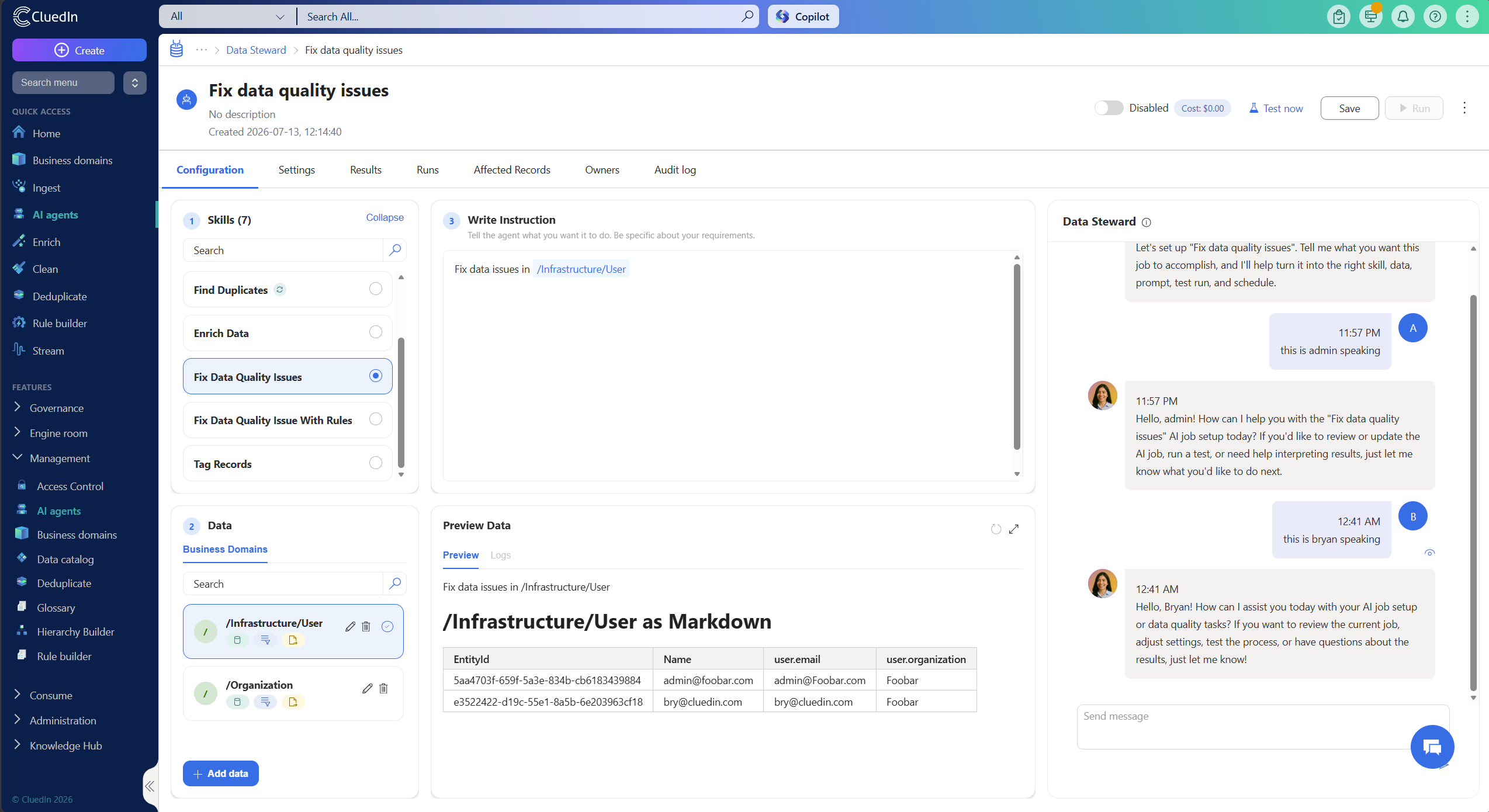
CluedIn is a graph-native Agentic Master Data Management platform with direct Microsoft MDS migration and coexistence capabilities.
Rather than reproducing MDS object for object, CluedIn combines mastering, entity resolution, Golden Records, data quality, governance, relationships, enrichment and governed AI agents.
It is particularly relevant where the wider architecture is already moving toward Microsoft Fabric, Microsoft Purview, Power Platform, Azure and AI-based data operations.
Informatica offers multidomain MDM alongside a much broader portfolio covering integration, data quality, governance, cataloguing and metadata.
Its current positioning extends into agentic MDM and trusted data for AI, with connectivity across environments including Microsoft Fabric, Databricks and other major data platforms.
Semarchy positions its platform around trusted multidomain master data, federated governance and AI-ready data, with cloud, container and on-premises deployment options.
Its current platform positioning also brings DataOps and Copilot capabilities into the MDM proposition.
Reltio's MDM proposition centres on cloud-native multidomain mastering, entity resolution, continuous data quality, dynamic survivorship and real-time trusted data.
SAP completed its acquisition of Reltio in May 2026 and has said the technology will contribute to its wider Business Data Cloud and AI-ready data strategy.
Ataccama combines MDM with data quality capabilities and supports cleansing, standardisation, matching and merging as part of the mastering process.
Its MDM product is data-source agnostic and designed to integrate into broader enterprise data estates.
Stibo Systems offers multidomain MDM designed to connect, govern and share master data across multiple internal and external sources.
Its platform supports relationships and hierarchies across domains and is commonly positioned around areas such as product, customer, supplier and other enterprise master data.
SAP MDG provides central governance, consolidation, workflow, approval, distribution and data quality capabilities for domains including business partners, products, financial data and custom objects.
It can be deployed as a hub or alongside SAP S/4HANA, which makes the surrounding SAP architecture an important part of the buying decision.
Most established MDM platforms can tick a lot of the same boxes. That does not mean they will produce the same architecture, operating cost or migration experience.
This is where the MDS decision becomes more architectural. Fabric can become the centre of analytics, data engineering and AI workloads without requiring your MDM platform to become another isolated island. A sensible architecture separates the jobs:
If your current MDS deployment is little more than fifteen reference tables and an occasional approval workflow, you probably do not need to turn its retirement into a major enterprise MDM programme. Keep the solution proportionate to the problem.
CluedIn becomes much more relevant when MDS is managing business-critical entities across multiple systems, when matching and survivorship matter, when stewardship is consuming significant effort, or when the mastered data now needs to support Fabric, governance, analytics and AI.
Microsoft has not switched MDS off. Existing SQL Server 2022 deployments remain supported. That breathing room is useful.
Use it to inventory what MDS actually does, identify the downstream contracts that matter, remove logic you no longer need and test the replacement architecture against a real domain before committing to an enterprise-wide migration.
The organisations that get this right will not simply have replaced MDS. They will have used its retirement to remove a chunk of legacy architecture and improve how trusted data gets produced in the first place.
Connect the existing MDS estate, validate the new mastered outputs alongside it and move downstream consumers progressively rather than forcing a single cutover.
Explore MDS migration with CluedIn Talk to CluedIn