
Earlier this year, CluedIn was recognised in two Gartner® Magic Quadrants™: as a Visionary in the 2026 Magic Quadrant for Master Data Management Solutions and as a Niche Player in the 2026 Magic Quadrant for Augmented Data Quality Solutions.
Two different markets. Two different evaluations. But we think the interesting part is what sits between them.
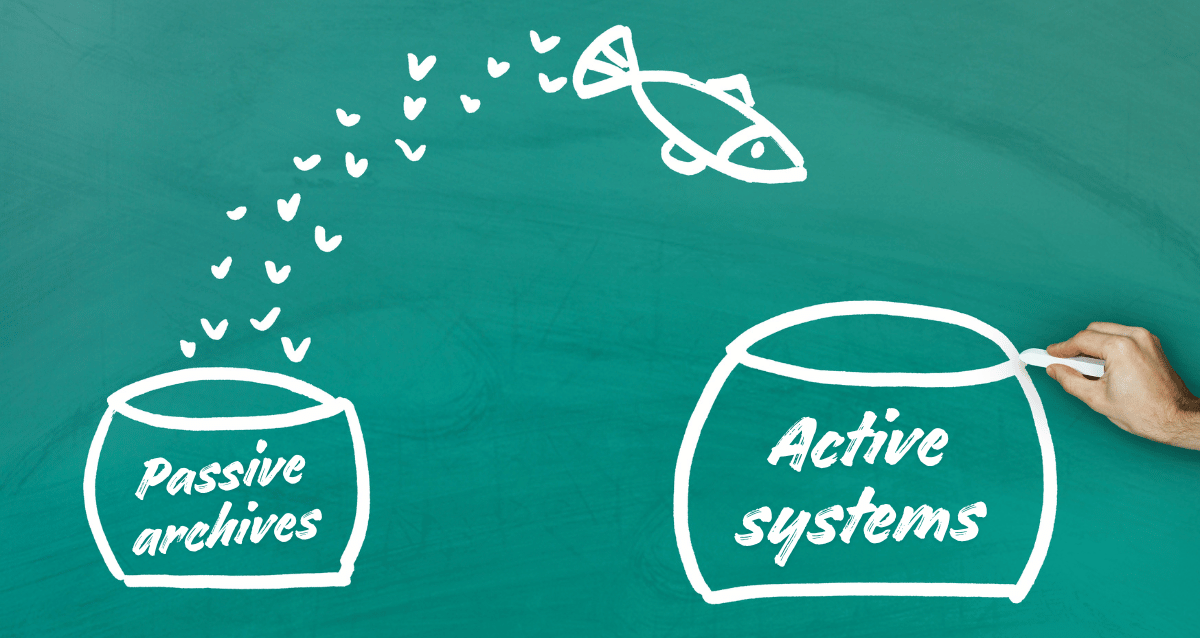
Enterprise data management is moving from systems that describe and organise trusted data towards systems that can continuously maintain it, understand it and act on it.
Gartner describes Master Data Management as helping organisations ensure the uniformity, accuracy and semantic consistency of shared master data. Its definition of Augmented Data Quality goes further into detecting and fixing errors, removing duplicates, standardising formats and validating data for trusted operational and analytical use. Look at the accompanying research and the direction becomes even clearer.
Gartner says organisations need “clean, AI-ready data” and describes Augmented Data Quality capabilities that can provide context-aware corrective suggestions and automate remediation using AI technologies. We believe that changes what Master Data Management needs to become.
The golden record is still essential. It just isn't the finish line.
For decades, one of the central goals of MDM has been straightforward: identify the right customer, product, supplier, asset or location and create a trusted representation of it. That problem hasn't disappeared. In an AI-driven enterprise, arguably it matters more than ever.
An AI system cannot reliably reason about a customer if it doesn't know which customer it is. It cannot understand supplier risk if the same organisation exists under five identities. It cannot make useful recommendations about products if classifications, relationships and attributes are inconsistent. But creating the golden record is increasingly the beginning of the problem, not the end.
A supplier changes. A new source system appears. A product catalogue expands. An acquisition introduces another ERP. A relationship changes. New information becomes available. A previously acceptable record fails a newly introduced policy.
Trust is not something an enterprise creates once. It has to be continuously maintained. That means the traditional boundaries between mastering, data quality, enrichment, governance and stewardship begin to disappear.
Data quality is moving from detection to action
Enterprise data teams have become extremely good at discovering problems. We can profile data. Score it. Monitor it. Build dashboards around it. Raise alerts when it deteriorates. But detecting a problem and resolving it are very different things.
A dashboard showing 40,000 quality issues has not improved 40,000 records. In many organisations it has simply created a better-informed human backlog.
This is where the direction of Augmented Data Quality becomes particularly interesting. Gartner's current Critical Capabilities research describes solutions that can streamline issue identification, provide context-aware corrective suggestions and automate remediation actions.
-
Was the value incorrectly formatted?
-
Can it safely be standardised?
-
Is a missing property inferable from trusted evidence?
-
Are two records genuinely duplicates?
-
Is confidence high enough to act automatically, or does this decision require a steward?
Those are not simply data quality questions. They require identity, context, policy, history and judgement.
AI makes action cheap. Context determines whether that action is safe.
Giving an AI model access to enterprise data is comparatively easy. Giving it enough context to act intelligently is considerably harder. Microsoft makes the point clearly in its current Fabric IQ documentation:
“Data alone is not enough.”
Microsoft Learn, What is Fabric IQ?
Its emerging model is based around representing business concepts as entities, properties and relationships, creating a governed semantic layer that people and AI agents can reason across.
Consider the difference between giving an AI system this:
And allowing it to understand that this record represents a customer, belongs to a particular legal entity, has relationships with three subsidiaries, was assembled from four source systems, has a particular provenance, is governed by certain policies, and was previously matched against another record but rejected by a steward for a documented reason.
The data may be the same. The context is completely different.
This is why knowledge graphs, semantics, lineage and policy are becoming increasingly important to enterprise AI. Agents need to understand not just what data exists, but what it means, how it relates and what they are permitted to do with it.
The next shift is from prompting AI to giving it responsibility
Most enterprise generative AI has so far been interaction driven.
-
A person asks. The AI responds.
-
A person requests an analysis. The AI produces one.
-
A person initiates a task. The AI helps complete it.
-
Agents introduce a different operating model.
Research published by Harvard Data Science Review in 2026 describes agentic systems as able to monitor conditions, detect issues, recommend actions and, in some circumstances, act within defined boundaries.
The operating model moves towards:
“Keep this domain at the required level of quality. Investigate deterioration. Resolve what you are authorised to resolve. Escalate what requires judgement. Prove whether your actions improved the data.”
That is a fundamentally different relationship between people, software and data. It is also the direction we are building towards at CluedIn.
Our latest work moves beyond AI that waits for individual instructions towards agents that can work proactively against defined outcomes. Those agents can use available context, perform permitted actions, measure the effect of their work and bring people back into the process when approval or judgement is required.
The important word isn't autonomous. It is accountable.
Governance has to move with the agent
This is where some visions of autonomous enterprise AI become uncomfortable. It is easy to imagine an AI agent fixing millions of records. The harder questions are the ones enterprise data leaders immediately ask.
-
Why did it make that decision?
-
Which evidence did it use?
-
What was it authorised to change?
-
Which policy applied?
-
What confidence threshold was required?
-
Who approved the exception?
-
Can the decision be reviewed?
-
Can its effect be measured?
These are not reasons to avoid agentic systems. They are the architecture required to use them seriously.
The World Economic Forum reported in late 2025 that '82% of executives planned to adopt AI agents within one to three years', while warning that 'experimentation was advancing faster than mature oversight'.
Its recommendations emphasise transparency, continuous monitoring and governance proportionate to the autonomy being granted.
The enterprise AI race may not ultimately be won by whoever gives agents the most freedom. It may be won by whoever can give them the most useful freedom within trustworthy boundaries.
For data management, that means permissions, policies, lineage, deterministic quality measurements, explanations, approval workflows and human intervention should not be added afterwards. They need to be part of the operating model.
The future of stewardship isn't removing the steward
There is another important consequence. Data stewardship does not disappear. But its unit of work changes. Highly skilled data professionals should not spend their time manually correcting the same formatting issue for the ten-thousandth time, reviewing obvious duplicates one by one or repeatedly enriching records where evidence and policy already make the correct action clear.
Their value is in deciding how data should behave. Defining policy. Handling ambiguity. Designing rules. Reviewing exceptions. Understanding business meaning. Setting acceptable risk. Deciding where an agent can act and where human judgement remains essential.
The future of stewardship isn't removing the steward. It's removing everything that never needed a steward in the first place.
This is one reason we see Agentic Data Management as an operating model rather than another AI feature. Rules still matter. Workflows still matter. Mastering still matters. Human judgement still matters. The difference is that increasingly, routine work can happen continuously around them.
We can already see what this looks like
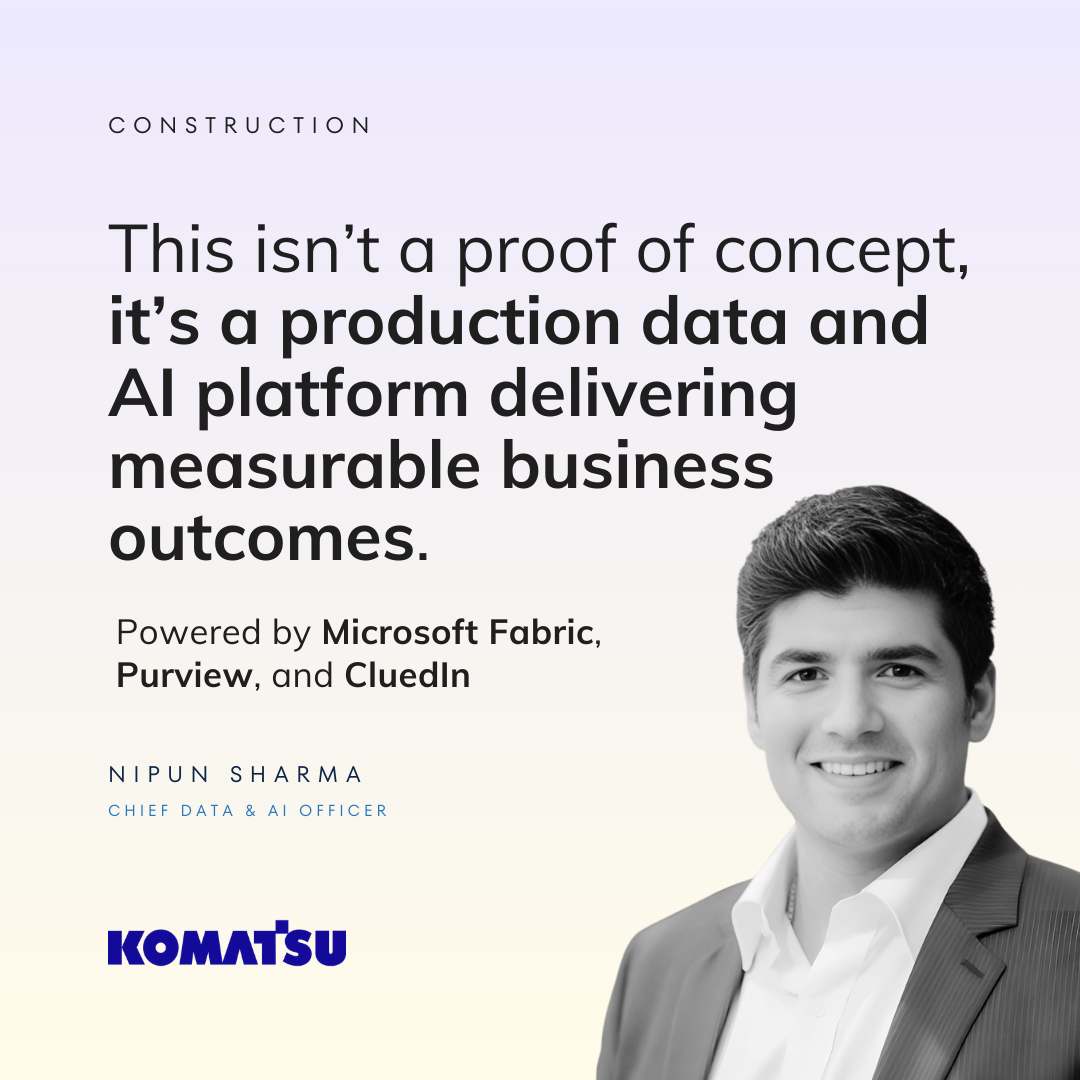
This is not purely a theoretical direction. At Komatsu, CluedIn is being used as part of a modern enterprise data environment processing up to 10 million records per day, with AI-driven data operations helping reduce the manual effort required to maintain trusted product data.
Other CluedIn use cases demonstrate the same principle at a task level: AI agents handling classification, enrichment and missing data at a scale where performing every operation manually would make little economic sense.
The point is not that every data decision should suddenly be handed to AI. It is that the economics of enterprise data management change when software can perform more of the repetitive work while experts retain control of the boundaries.
MDM and data quality are starting to become one continuous loop
Put these changes together and the shape of the next data management model starts to emerge. Master Data Management establishes trusted entities and identity. Continuous data quality maintains their integrity. Semantic models and knowledge graphs provide business meaning and relationships. Governance establishes policies, permissions and acceptable actions. AI agents observe that environment, reason over its context and perform authorised work. Deterministic measures establish whether that work actually improved the result.
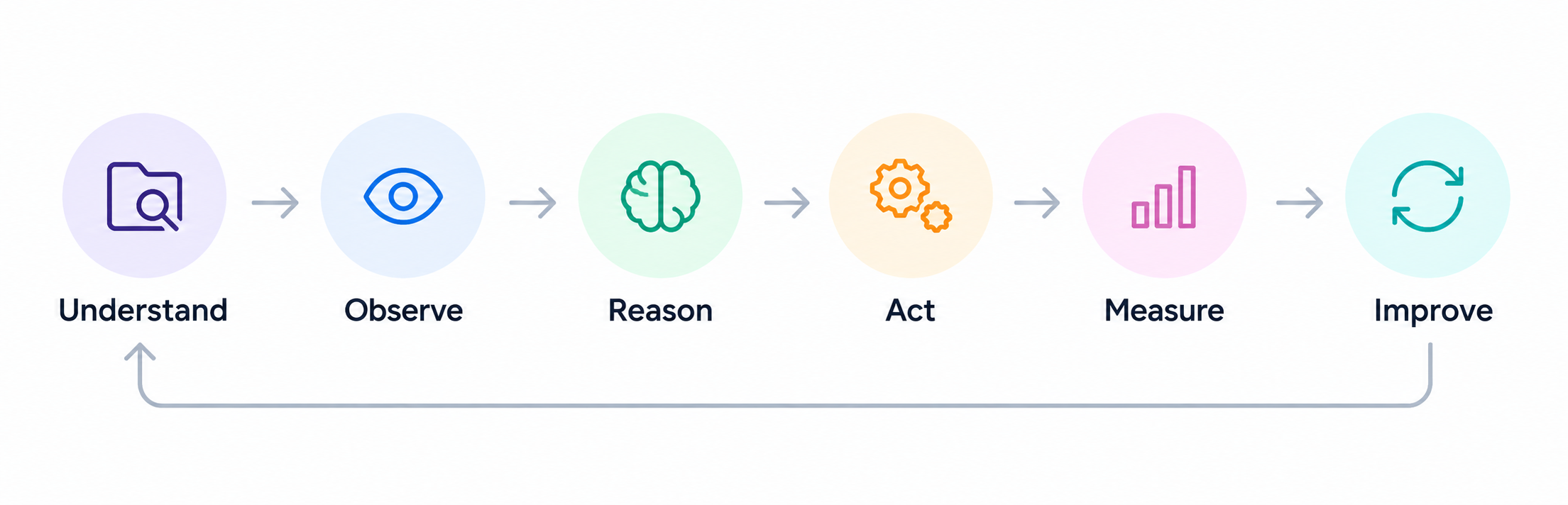
Then the cycle starts again. That is very different from periodically cleaning data and publishing another golden record. It is a continuously operating data foundation. And as enterprises increasingly expect AI to participate in business processes, analytics and decision-making, that foundation matters far beyond the traditional boundaries of MDM.
Two markets. One increasingly connected problem.
Being recognised in two Gartner Magic Quadrants matters to us. But not simply because there are two pieces of analyst recognition. CluedIn was positioned as a Visionary for Master Data Management and a Niche Player for Augmented Data Quality. Those are different evaluations of different markets.
What interests us most is how quickly the underlying requirements are converging.
Can we create trusted enterprise data, understand what it means, keep it trustworthy as things change, and allow people and AI to act on it safely?
We believe that is where modern Master Data Management is heading. Not away from mastering. Beyond mastering. Towards data that continuously improves, carries its business context with it, and can support a new generation of governed, intelligent operations.
Recognised in two markets.
Building for where they meet.
Gartner research referenced:
Gartner, Magic Quadrant for Master Data Management Solutions, Stephen Kennedy, Lyn Robison, Divya Radhakrishnan, 6 April 2026.
Gartner, Magic Quadrant for Augmented Data Quality Solutions, Sue Waite, Divya Radhakrishnan, Amy Bickel, 11 February 2026.
Additional research:
Gartner, Critical Capabilities for Master Data Management Solutions, 2026.
Gartner, Critical Capabilities for Augmented Data Quality Solutions, 2026.
Microsoft Learn, What is Fabric IQ?
Harvard Data Science Review, research on agentic systems, 2026.
World Economic Forum, AI Agents in Action: Foundations for Evaluation and Governance, 2025.
Gartner does not endorse any company, vendor, product or service depicted in its publications, and does not advise technology users to select only those vendors with the highest ratings or other designation. Gartner publications consist of the opinions of Gartner’s business and technology insights organization and should not be construed as statements of fact. Gartner disclaims all warranties, expressed or implied, with respect to this publication, including any warranties of merchantability or fitness for a particular purpose.