Microsoft Master Data Services
Microsoft MDS Replacement After SQL Server 2025
Microsoft Master Data Services has been removed from SQL Server 2025.

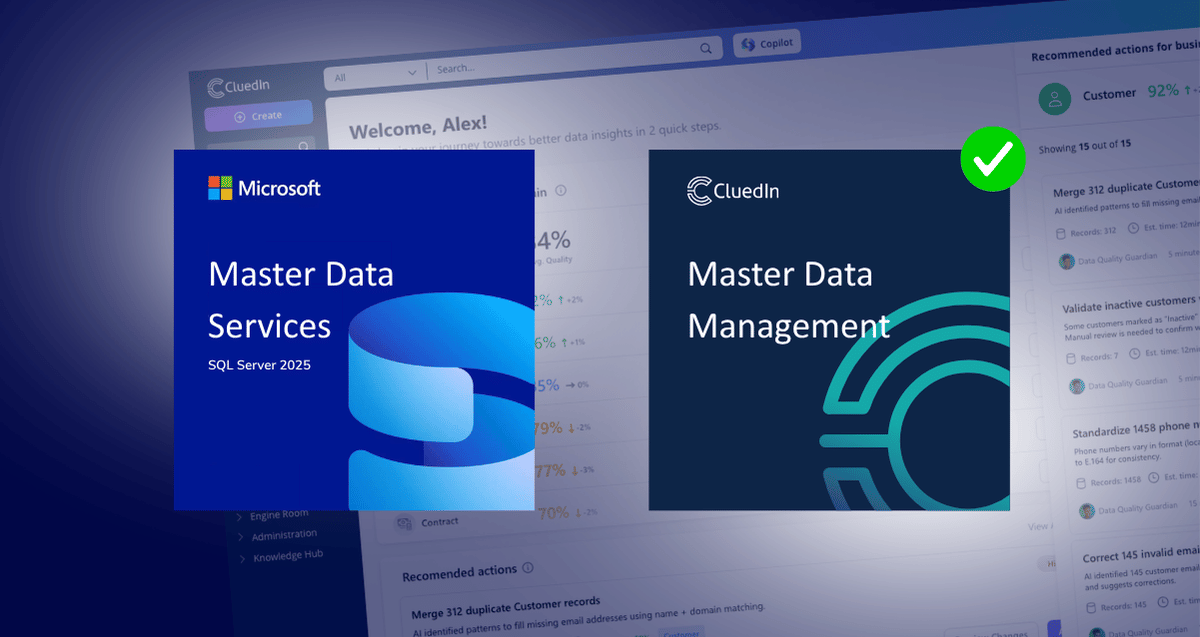
Microsoft Master Data Services has been removed from SQL Server 2025. That does not mean existing MDS implementations suddenly stop working. Microsoft continues to support MDS in SQL Server 2022 and earlier versions.
But it does mean organisations relying on MDS now have a clear architecture decision to make: what replaces it, and how do you move without turning years of master data logic into a high-risk migration project?
Master Data Services is no longer included in SQL Server 2025. Microsoft continues to support MDS in SQL Server 2022 and earlier versions.
So there is no immediate shutdown. But there is now a clear ceiling for organisations planning future SQL Server upgrades or wider data platform modernisation.
MDS has traditionally been used to define and manage models, entities, attributes, members, hierarchies, business rules and mastered outputs. Microsoft describes an MDS model as the highest level of organisation for master data, containing entities, attributes, hierarchies and collections. That model has served many organisations well.
The issue is not that MDS suddenly stopped being useful. It is that it no longer has a place in Microsoft's forward SQL Server platform.
There are broadly four.
For some organisations, this will be the right short-term decision.
If the existing MDS environment is stable, business-critical and expensive to change, remaining on a supported SQL Server version can buy time.
But it should be treated as a transition strategy rather than a long-term architecture decision.
Some organisations may decide to recreate parts of MDS using SQL Server, Dataverse, Power Platform, Fabric or custom applications.
For lightweight reference data management, this may be perfectly reasonable.
The risk is scope creep. What starts as somewhere to maintain records can quickly turn into rebuilding matching, rules, hierarchies, stewardship, workflows, history, publishing, permissions and governance.
For organisations using MDS as a genuine enterprise mastering platform, moving to a purpose-built MDM system is usually the more sustainable option. That creates an opportunity to improve areas such as:
This is the approach we generally recommend. It reduces risk, allows existing MDS contracts to remain in place temporarily and gives teams time to prove the new mastering model before cutting consumers over.
Usually, no. A mature MDS implementation can accumulate years of business rules, extraction logic, hierarchies, stored procedures and workarounds.
Some are essential. Some only exist because MDS required them. Others survive because nobody has been confident enough to remove them.
Subscription views are often one of the most important parts of an MDS estate because downstream systems depend on them.
In CluedIn, mastered data is published using Streams and Export Targets.
They should not simply be copied. An MDS business rule can combine several responsibilities, including validation, defaulting, notifications and control of which records are considered valid.
In a modern MDM platform, those responsibilities may become:
This is where an MDS replacement can become more than a technology refresh. CluedIn is built around graph-native Master Data Management, where entities, relationships, lineage and governance context are maintained together.
Not with a giant target-state diagram. Start by identifying one domain and one real downstream consumer.
No. For Microsoft-first organisations, replacing MDS can become part of a wider data modernisation programme.
CluedIn sits alongside technologies such as Microsoft Fabric, Microsoft Purview, Azure and Power Platform, handling mastering, entity resolution, data quality, enrichment and governed data operations between source systems and downstream analytics, AI and applications.
That is the wrong deadline. MDS remains supported in SQL Server 2022 and earlier.
If MDS is a small reference data application, the answer may be that you can leave it alone for now. If it sits at the centre of customer, product, supplier, asset or other business-critical master data, the case for planning the transition is much stronger.
CluedIn supports direct MDS connectivity, SQL-based ingestion, coexistence and hybrid migration patterns, so you can validate mastered outputs before progressively moving downstream consumers.
Explore MDS migration with CluedIn Read the technical migration guide